[ Published here : https://bit.ly/3LRMb3Z ]
Conflict & Security
Iraq’s Change politicians Face Difficult Odds in Upcoming Provincial Council Elections
- Iraq will hold its’ first provincial council elections in more than ten years on December 18, 2023
- Change political movements, while still minor players within the political system, continue to grow and evolve. The formation of the Democratic Forces of Change political alliance and the Civic Values Alliance competing in these elections are examples of such achievements, even if they aren’t expected to win many seats.
- Change politicians and parties continue to suffer from setbacks. But change parties’ shortcomings are actually intrinsic to the condition of post-2003 political parties and nascent democratic politics in Iraq, and not specific to change parties themselves. Problems include overreliance on boss style leadership, lack of developed political ideologies and platforms, and ego-driven personality politics, of which the dominant political parties are the biggest offenders. Iraq has not yet become a consolidated democracy.
- Dominant political elite appear ready to use any means necessary to hold on to power and remain one of the biggest barriers to change politicians’ political development and reform in Iraq more generally
Introduction
On the eve of Iraq’s provincial council elections, analysis of Iraqi politics continues to focus on the role of the dominant factions competing for preeminence in the Iraqi state. But more than four years after the seminal 2019 Tishreen protests calling for change, a growing number of groups not aligned with the status quo are organizing themselves into an electoral coalition to press for change. “Change politicians” as I have dubbed them in previously published reports[1], are change-oriented independent politicians and emerging political parties whose primary objective is disruption of the status quo through the current political system.[2] Most change politicians’ political ideologies are nascent and evolving. They juxtapose their civil, madani identity focused on equality, national, non-sectarian identities with dominant elites’ focus on preserving their grip over the political system and dividing state spoils. Interviews suggest that while change politicians are still a long way from holding power, they are engaged in somewhat genuine attempts to build a politics separate from the status quo scramble for shares of state resources.
December 18 will see the country’s first provincial council elections since 2013 and following their disbandment and subsequent dissolution by parliament in 2019. While change politicians made an impressive first showing in the 2021 parliamentary elections, infighting and divisions have since slowed their progress, as have allegations of corruption, misadministration, and leadership disputes, among other issues explored at length below.[3]
Change politicians’ presence in parliament was at first overshadowed by an impasse between two opposing political blocs over government formation which culminated in bloodshed. With the appointment of Prime Minister Sudani, Sudani and his Coordination Framework backers finally formed a government in late 2022. Since then, although a sense of superficial calm has prevailed, change politicians are continually forced to reexamine their movement and their strategies due to the tumultuous, unpredictable nature of Iraqi politics. The emergence of the Democratic Forces of Change political alliance and the electoral coalition Civil Values Alliance (CVA) are significant steps as they attempt to gain their footing. They are fielding candidates in 15 provinces across the country.
Examination of change politicians positioning within the broader political landscape ahead of December’s elections reveals several key analytical takeaways about change politicians and the Iraqi political system more broadly.
First, by contextualizing change politicians’ current trajectory within broader Iraqi politics disproves some common, and misguided, analyses which present deficiencies as specific to the political immaturity of change politicians. Common critiques of change parties often fail to contextualize that such shortcomings are actually intrinsic to the condition of post-2003 Iraqi political parties more generally. For example, lack of developed political programs, boss-style leadership, and ego-driven personality politics are shortcomings of post-2003 Iraqi political parties across the board, not of change parties specifically. Post-2003 ruling political parties are dominated by strongmen with constructed identities who have yet to set forth credible political ideologies and sustainable programs which continue to fail the Iraqi people despite substantial wealth generated by the Iraqi petrostate. Political evolution, both amongst politicians and voters, is therefore key for Iraq’s development towards a consolidated democracy. Criticism of change politicians is warranted and needed to hold change political actors to account, but failure to contextualize shortcomings obfuscates the reality of an underdeveloped political party and democratic system more generally.
Second, change politicians and parties, despite internal pitfalls and external pushback, continue to evolve and grow and are among the few in the political system advocating for reforms. Garnering little interest thus far from the international community, provincial council elections are in fact an important bellwether for nationwide political trends and for testing the strength of political parties. Provincial elections are often dubbed “practice runs” for upcoming parliamentary elections. Although election results are affected by many factors, the election law is one of the most important. This electoral law differs significantly from 2021, and trends largely in favor of traditional parties. In this context, as one change politician said, securing wins, even if small, would undermine the Coordination Framework’s claims of corruption as the reason for the 2021 election outcomes and cement them as real political contenders within the system, even if minor.[4] Potential major losses does not mean they should be discounted in the long run, as movements take years, if not decades, to build– but wins are important to cement a foothold in the system to be leveraged over the longer term. Even smaller wins should be watched closely. The current change parties and alliances may fail in the short-term but process towards sustainable democracy is often not linear.
Third, change politicians continue to face many challenges. But their biggest challenge, however, remains the dominant elite, many of whom appear willing to use any force at their disposal—whether legal, illegal, or violent—to maintain their positions of power.[5]
Change politicians face stiff competition from powerful, better funded dominant political parties competing against them in the elections. But they also face pressure due to populist Shia cleric Muqtada al Sadr’s announcement on November 14 to boycott the elections[6]– social media was flooded afterwards with images of alleged Sadrist supporters shown ripping down election posters in the street.[7] Sadrists’ lack of participation in the election means that one of the biggest political players will, on an official level, remain absent from the provincial council political scene. Other parties have subsequently followed suite and announced their own boycott.[8] Meanwhile, a Supreme Court decision to remove powerful Sunni leader Mohammed al Halbousi from his seat as speaker of Parliament, has resulted in the delay of electing a new speaker. The political environment remains unpredictable.
Sadrist boycott poster on the street in Iraq’s southern Dhi Qar province. Photo by Haley Bobseine

Between August 2022 and December 2023, I conducted dozens of interviews inside Iraq with political party members, party supporters, activists, election specialists, and others from across the political spectrum to better understand change politicians’ positioning and strategies moving forward. For this report in particular, I conducted more than 40 interviews with members of parliament, change politicians, provincial council election candidates, Iraqi and international political and election specialists, independents aligned with traditional parties, activists and journalists. Most interviews were conducted in Arabic in Baghdad, with some interviews conducted in person in Erbil and Basra, and several more conducted over the phone. Many individuals spoke on condition of anonymity due to the sensitivity of some issues, and are identified by their affiliation.
Post-2003 State: Iraqis’ disillusionment + a Democracy that has yet to consolidate
The 2003 U.S.-led invasion reset the country’s political order. Alongside the foreign occupation, exiled oppositionists returned to shape a post-Saddam Iraq. The result was a state based on an elite bargain of identity-based power sharing, its rough framework the outcome of meetings held in exile in the 1990s, between mostly opposition Shia Islamist and Kurdish nationalist groups, and later empowered by occupation forces.[9] Thus emerged Iraq’s muhassasa, an informal ethno-sectarian apportionment system still adhered to today. Muhassasa is key to dominant elites’ staying power and to maintaining patronage networks within the Iraqi political system.[10] Other domestic movements, rejecting the US-led occupation, also sought to push back and shape the new state through violence.[11] Lacking a long-term plan, the US-led occupation inflicted egregious wounds on Iraqi society while Iraqi rival factions pursued short-term interests and zero-sum gains.[12]
Twentieth century history chronicles a long list of violence inflicted on Iraqis who lacked adequate state protection and democratic representation- foreign mandates, bloody coups, the Baath regime’s violent rule, the Iran-Iraq war, crippling international sanctions imposed during the 1990s, etc. Political repression under Sadam’s rule made those wishing to express opposing political views reticent- “people were even afraid of the wall,” says one longtime activist.[13] But for many Iraqis across the ethno-sectarian spectrum, the Iraqi state post-2003 has also failed to meet their basic expectations of a functioning state.[14] Corruption is rife and political news reads like a dark tale of impunity, political rivalries, personal feuds, and competition over government postings—not differing approaches to policy making.[15]
Immediately following the US-led invasion, some structural changes allowed for the establishment of civil society organizations, NGOs, opposition civil political parties, news platforms, etc.[16] But broader violent conflict across the country and attacks against such groups stifled their development.[17] This, coupled with general Iraqi frustration with the post-2003 state and ruling elite, compounded over the years and protests became one of the few avenues to express discontentment. The Tishreen movement emerged in 2019 as a leaderless, youth-driven grassroots movement.[18] While protests had happened before—with notable peaks in 2012, 2015, and 2018—none since the U.S.-led invasion of 2003 were as large as the protests of 2019. The Tishreen movement is essential to understanding the rise of reform-oriented politics active today.
In October 2019, civil society organizations, student unions, older civic-minded parties, longtime activists (including, at times, the Sadrists), and others joined the majority young, politically nonaligned activists in the streets.[19] The Tishreen movement emerged as a pure expression of rage at status quo politics. In the protests, one longtime activist said, the “action preceded the theory.”[20] There was no clear set of demands or values that bound them all together in the beginning.
Demonstrators wanted basic political and economic reforms, including jobs for youth. Once the state responded with violence to these peaceful demonstrations, they escalated their demands, calling for an overhaul of the political system. Iraqis had had enough of elite consensus politics in which corruption thrived—they demanded accountability and consequences for the unidentified security personnel who ended up killing at least six hundred demonstrators.[21] The protests wound down in 2020, due to violent repression, the onset of COVID-19, and various other domestic and international factors.[22]
Some activists sought to harness the political energy of protests to transition from protesting to political organizing. Highly skeptical of the post-2003 political order, they decided that peaceful reform from within was nonetheless the best way forward.[23] Thus, many activists who were once prominent in the Tishreen movement now lead or have joined emerging parties[24] established during the Tishreen protests and leading up to the 2021 parliamentary elections or campaigned on similar platforms as independents. In this way, Tishreen succeeded in unseating the government, pushing parliament to adopt a new electoral law, and brought in Iraq’s first sizable bloc of nonaligned members of parliament.[25]
But shortly after assuming office, the 2022 government formation power struggle crippled the political scene, pitting the Sadrist Movement, led by populist Shia cleric Muqtada al-Sadr, against the Coordination Framework, a loose grouping of Shia parties, united mostly by their opposition to Sadr.[26] While prolonged government formation negotiations are the norm in Iraq, the period marked the longest impasse since 2003. After the Sadrist Movement won seventy-three seats in the October 2021 election—the best showing of any faction—Sadr eschewed the customary practice of forming a consensus government among dominant political parties (or tawafuq in Arabic) and instead sought to form a “national majority government” with the allies of the now defunct tripartite alliance, the Kurdistan Democratic Party, and the Sunni Sovereignty Alliance.[27]
But Sadr’s attempts to form a national majority government were stifled on multiple occasions.[28] By June 2022, Sadr had apparently had enough, instructing his members of parliament to resign[29] and his supporters staged a nearly month-long sit-in .[30] The sit-in only ended after a series of escalating confrontations that ended in violence: On August 29, 2022, groups aligned with particular armed factions within the Coordination Framework and the PMF[31] clashed with Saraya al-Salam—the “Peace Brigades,” the Sadrist Movement’s armed wing—leaving more than thirty people dead and many more wounded.[32] The next day, Sadr announced his “resignation” from politics.[33] Current Prime Minister Mohammad Shia al Sudani, backed by the Coordination Framework (CF), succeeded in forming a government in October 2022. Since then, Iraq has witnessed a modicum of quiet stability but unresolved issues– political, legislative, administrative or otherwise- continue to boil under the surface. Real solutions have yet to be found. Lack of or low level of protests should not be misconstrued as a barometer of satisfaction with the government. “Many protests are politicized and used by traditional parties to score points against their opponents. Also, the Tishreen protests saw so much killing, a lot of people are trying to focus on engaging on the political level for the time being,” said one political activist from Basra.[34]
Some critics allege that Sadrist protests were a missed opportunity for change politicians and protest groups to cooperate more closely with Sadrists in protesting against the CF’s dominance over the government formation process. Indeed, some protester and political groups continue to look to the Sadrists as they gauge their next political moves. But one change political party member rejected this outright, saying “the Sadrists went into the street in their name, not in the name of reforms. The name of the revolution, the Ashoura Revolution, was not national and inclusive…we asked ourselves, should we help the Sadrists get the government? Or should we advocate for a reform government?” Another activist agreed that not joining the Sadrists’ Ashoura Revolution was the right move but says they missed an opportunity to pressure for a more independent prime minister or other reform-related concessions after the August clashes, later in October. “There were plans for bigger protests but ruling elites successfully coopted or paid off some people…both protesters and politicians…so plans never got off the ground,” the political activist said.[35]
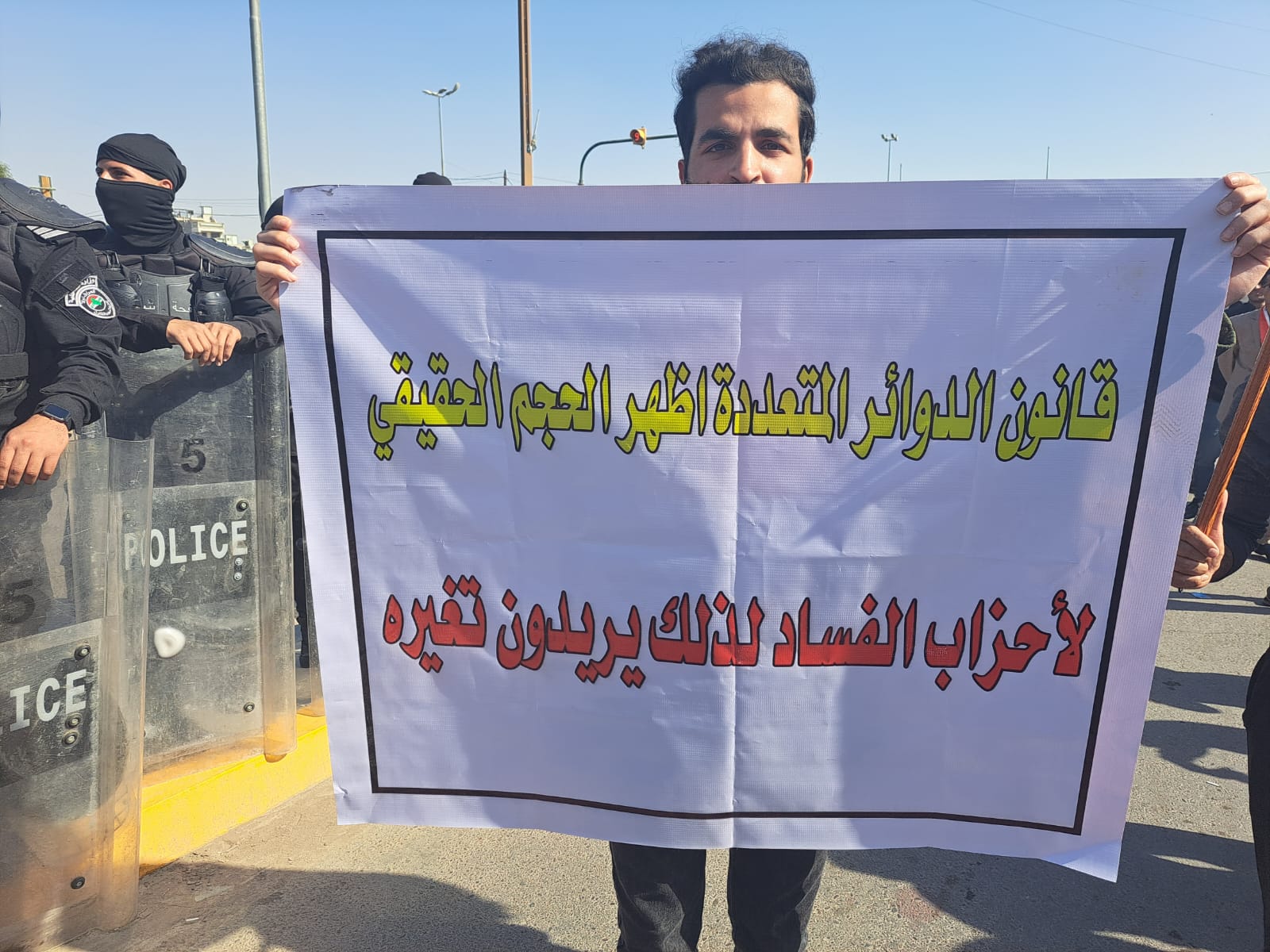
After Sudani assumed the premiership, the Coordination Framework made good on their promise and prioritized rolling back the 2021 parliamentary electoral law under which Coordination Framework parties generally performed poorly, and protested the results, alleging fraud.[36] The new electoral law passed in 2023 designates entire governorates as a single electoral district and establishes a system of proportional representation using the Sainte-Laguë method divisor of 1.7. The law inherently favors large, established parties and electoral coalitions, benefitting the CF and its allies. Research conducted by Iraqi civil society organizations indicate that the new law is not welcomed by the general Iraqi public[37] and analysts claim that because it deprives voters of the ability to elect representatives at the local district level, it makes it “more difficult to hold politicians accountable and discourages citizens from voting.”[38] The new law is also perceived as a setback for one of the few tangible achievements of the Tishreen movements.
Protesters protest against calls for the passage of the Sainte-Laguë electoral law on the streets in Baghdad on February 27, 2023. Photos by Haley Bobseine.


Federal Iraq (of Iraq’s 18 provinces, the 3 Kurdistan Regional provinces will not join the 15 federal Iraq provinces in the vote) will hold provincial council elections for the first time in ten years on December 18. The last provincial council elections occurred in April 2013 but overextension of their mandates and pressure from protesters resulted in their dissolvement in October 2019. More than 16 million Iraqis are eligible to vote but this number could have been higher- voter apathy, political and electoral system frustrations, and failure to update their biometric information before the deadline means that several million Iraqis will not be able to vote in this election. More than 6,000 candidates are competing for 275 provincial council seats, with an additional ten seats reserved for minorities.[39]
Provincial Councils were established under the 2005 Iraq constitution in part as a check on the expansive powers wielded by the central government during Saddam’s times. Provincial elections select provincial council members, who in turn have the power to elect and dismiss the governor.[40] Funded by the national budget, the councils perform legislative and monitoring functions but remain dependent upon the central government’s set budgeting for which they may amend projects accordingly.[41] Nonetheless, provincial council elections remain crucial for building patronage and party influence networks.[42]
Defining Change Politics and Madani Identities
Change politicians articulate a different approach to power in Iraq, removed from the violence and muhassasa that is hollowing out the political system. While exact positions may differ from one party to the next, in interviews change politicians say issues which unite them are the rejection of political violence, corruption, weapons outside of the control of the state, muhassasa, and calls in favor of “genuine reform” of the political system. They distance themselves from sectarian political rhetoric and instead endeavor to reconceptualize Iraqi identity and the relationship between the state and its citizens. Key to this is a civil or madani identity. “Different from how its normally defined in the west, madani in Iraq means a national, non-sectarian identity. Before identity used to be Sunni, Shia, or Kurdish…but those parties don’t represent us…madani has now become a national political identity. The embrace of the madani identity is one of the successes of civil movements since 2003 and of Tishreen,” said Sharouq al Abayji, general secretary of National Civil Movement.[43]
According to the Iraqi madani concept, national citizenship, rule of law, inclusivity, human rights, equality and strength of institutions are prioritized. Cognizant of Islamist and conservative critics, change politicians emphasize that madani advocates for the separation of religion from politics but does not denote secular which is often synonymous with atheism in Iraq and which is largely rejected by Iraqi society. As Anwer Aziz, a member of the political office of change party Emtidad explained, “As a party, we are a madani party. As for party members, some are very religious and others are not as religious.”[44] Sharouq al Abayji explains, “We are a civil party, obviously not a party looking to combat religion.”[45]
Change politicians juxtapose their civil madani identity with dominant elites’ focus on preserving their grip over the political system. They often refer to themselves as the “third way.”[46] Through occasional protests, media statements[47], highlighting the ruling elites’ failure to address Iraqis’ needs while using violence to settle political scores[48], and playing the role of opposition within parliament over the past year and a half, they are attempting to navigate a path forward to press for reform. Attempts to evolve the political agenda and carve out an emerging political madani identity from inside Iraq is an unprecedented development in Iraq’s post- 2003 trajectory.
Most change politicians’ political ideologies are nascent and evolving. But focusing on the level of ideology sophistication alone obscures the broader picture. “We have strategies but our political ideologies are still under development,” said Hussein al-Guorabi, general secretary of emerging party al-Beit al-Watani said at the time.[49] Some reject the term “new” when describing their political parties. “There are lots of new political parties in Iraq. While many of us are new, we distinguish ourselves as parties calling for change- most other new parties are just new iterations of the same political elite,” said Khalid Waleed, the media spokesperson for the change party Nazil Akith Haqi Democratic Movement.[50] Iraq’s democracy is not consolidated—democratic institutions are weak and society’s embrace of it is not firmly rooted. Iraqis also are trying to figure out what Iraqi democracy means to them. A former MP, who returned from exile to Iraq after 2003 after living in Europe for a number of years explained, “Before I went to Europe, in Iraq under Saddam’s times we only knew that three types of parties existed- Islamists, nationalist Baathist parties, and the communist party. In Europe, I learned that there was more to the leftist movements than just the communist party. I was exposed to other parties and political platforms,” they said.[51]
When asked about why some of the change parties don’t have better developed political ideologies, one politician retorted, “Why doesn’t the international community ask this of the traditional political parties? Most of them have no real ideology or political platform.”[52] Another change activist said, “We can’t push a button and go from demonstrators to an advanced party…we need money, resources, and time…We don’t have strong international relations, we aren’t leading state institutions, and don’t have a lot of resources. The international community needs to be more realistic with the reality of their situation,” he said.[53] Another change politician and lawyer explained to the author, “the constant belittling of change parties’ capabilities is part of the ruling parties’ attack strategy against us. We have awareness and experience in politics. And they don’t have very developed political platforms either…they seek to delegitimize us,” he said.[54]
One Iraqi election expert agreed that change politicians suffer from shortcomings similar to other political parties post-2003 and that this is not specific to them. But, he says, “Change parties need to show they have a new way, that they have an agenda. They engage in too much random work right now. If they have no money, resources, but also no agenda, how will they compete? With better agendas, they will gain a strategic plan, if they want to build themselves as a party and have real expectations about themselves. Having a better platform, they will gain a strategic win. It will also allow us to know what to expect and what their duties are. Their duty is to form a new model of political parties in Iraq- if they don’t form a new model, why are people supporting them? If they don’t make good parties in a bad political system…which is still not yet a full democracy, it will be hard to bring about change. If they build strong parties, they will have a stronger movement for change.”[55]
Emerging change political parties are mostly drawn from majority Shia, Arab regions of Iraq, and many of its senior members were part of the Tishreen protests. This is due to Tishreen protests occurring in mostly Shia Arab areas of central and southern Iraq, even though Sunni and Kurdish youth there share similar grievances as their Shia counterparts.[56] Sunni-majority areas were reportedly “still reeling from the destructive aftermath of the fight against ISIS and feared confrontation with the government, even if peaceful, could end in their arrest due to overbroad accusations of affiliation with ISIS or Baathists.”[57] According to a political activist from Western Anbar province, “There were protests in years past, such as in 2012[58], but then extremist groups took advantage of them. So, people in Anbar were scared when Tishreen protests broke out. But, we still saw Tishreen as a national issue and we supported them in other ways, like sharing supportive information on facebook… but Halbousi clamped down on them hard and used security services to arrest people for just writing on facebook. Many people then stopped this work or other activists were coopted by Halbousi,” he said.[59]
Therefore, although change politicians are mostly Shia, they are not basing their program on a Shia identity to gain supporters and convince voters to vote for them to “protect Shia interests.” Instead, they are actively trying to recruit beyond their traditional bases, and foster a cross-ethnic following across the country, highlighting the Iraqi madani identity which represents all Iraqis. The support of change candidates in ethno-religiously diverse areas and majority Sunni areas in the upcoming elections, as described in sections below, is such an example.
Mapping Major Change Political Parties
Capitalizing on the momentum of Tishreen, change politicians succeeded in bringing Iraq’s first sizable bloc of nonaligned members of parliament in 2021.[60] The fact that a number of change politicians did well, despite violence and low turnout, was a testament to Iraqi voters’ appetite for change and the fortitude of change politicians’ organizing and campaigning on limited budgets.[61]
Born out of the Tishreen protests, several emerging, change political parties have become increasingly active over the past few years. Emtidad participated in the elections and secured seats in the double digits.[62] Emtidad subsequently joined forces with the New Generation Movement (a party based in Sulaimani in Iraq’s mostly Kurdish north) to form the Alliance for the People, a parliamentary alliance.[63] The alliance was later dissolved[64] and a number of Emtidad’s MPs have subsequently left the party, some critical of leader Alaa Rikabi’s alleged “dictatorial leadership style,” and some joined other parties.[65] Emtidad is in the process of internal restructuring, noting that “We are a young party born during exceptional, violent times, and such things take time,” a member of Emtidad’s political office said.[66] Although they are not competing in this month’s elections, the official confirmed “we are not boycotting elections, as individuals, Emtidad members are welcome to vote or not…we will not hurt ourselves and the madani cause….we reject this particular Sainte-Laguë law….we don’t reject provincial councils, as they are an important part of democracy.” The party member earlier told the author that, “When we ran for parliamentary elections in 2021, and several parties withdrew and decided to boycott, this created trust issues for us…trust was lost when we were trying to present a united front,” he said.[67]
Other Tishreen parties such as secretary general Mushriq al-Furayji’s emerging party Nazil Akith Haqi Democratic Movement competed in 2021 and did not win any seats but will competing in the provincial council elections. Other parties, such as Hussein Ghorabi’s al-Beit al-Watani (the National Home), boycotted[68] the 2021 elections, citing high levels of violence and intimidation against their members and supporters[69] but are now fielding candidates in this month’s provincial council elections. Ghorabi’s party has also witnessed a number of party members leave over the past few years, forcing some of its own internal restructuring.[70]
Ishraqat Kanoun[71] political party emerged after the Tishreen protests but has mostly kept a separate identity, although its aim of gradual political and economic reforms through the existing political system is similar. Ishraqat Kanoun secured 6 seats in the 2021 parliamentary elections and then a 7th seat after the Sadrists withdrew from parliament. The party evolved from humanitarian networks into a political organization. In interviews, Iraqi political and election experts agree that they have a strong organizational structure and are the best organized change party administratively.[72] The party has not witnessed any major defections and has stayed mostly coherent in its messaging of combatting corruption, reform, and being transparent. It originally rejected the Sainte-Laguë electoral law but nonetheless will be competing in the upcoming provincial council elections. It notably published its expenditures online in a bid of transparency and to underscore their claimed anti-corruption stances.
Some dissenters have accused the party of having formal or informal ties with Shia shrine institutions, a claim which they adamantly deny and which senior clerics previously also denied. Some of party members are employed by the shrine institutions and enjoy support within the broader network but as someone close to Ishraqat Kanoun said “this is normal as it is a major employer in central and southern Iraq…this does not mean there is an official affiliation… they are a civil party with a program and not an Islamist party. Most Iraqis are Muslims…they are a party with conservative religious values.”[73] Because of their conservative religious values, one electoral expert explained “in the future, the party may be able to attract votes away from some traditional Islamist parties, which other madani parties may not.”[74]
When asked about Ishraqat Kanoun, a member of another change political party said “We have a lot in common, but in general I feel like they want to stand alone to preserve their own identity. Moreover, there are few key issues we differ on, such as personal status laws.”[75] Ishraqat Kanoun is not part of the Civil Values Alliance described in the sections below.
Some change parties emerged after 2003 but before Tishreen have expanded their membership to include more youth and activists who were involved in Tishreen such as the Social Democratic Current (SDC)[76] led by Alaa Rifaai. The Social Democratic Current was established in 2018 before the Tishreen protests. According to members of their political office, after Tishreen the party expanded its membership, including its’ leadership, to include more youth and activists who were involved in Tishreen.[77] One example is the party’s candidate, Ali Nour, who is running for a seat on Basra’s provincial council and is involved in environmental and political activism work.[78] Shuruq al-Abayaji[79], a former MP and general secretary of the National Civil Movement, a civil party founded in 2015, has become increasingly active in its coordination with emerging change parties. MP Basim Khazal[80] from Muthana is currently aligned with the party in parliament.
Civic Values Alliance and Social Democratic Current Basra provincial council electoral candidate Ali Nour. Photo from Ali Nour’s Instagram page1:

Another key player in madani political scene is the Iraqi Communist Party (ICP). Established in the 1930s and wielding a powerful presence in Iraqi politics during the mid-20th century, it opposed the US-led invasion of Iraq but ultimately decided to participate in the political process that followed. A brief electoral alliance with the Sadrists in the 2018 parliamentary elections[81] ended when their MPs withdrew from parliament in 2019 over the violence inflicted against Tishreen protesters and because the state “was not able to protect or answer to their demands,” one Iraqi Communist Party member said.[82] They boycotted the 2021 elections. The Iraqi Communist Party’s coordination with parties that emerged out of Tishreen reflects a new outlook. “We are going through a new phase. Our party leadership in Baghdad and in the provinces is 80% made up of people under 40 years old,” Iraq Communist Party political bureau member Yassir Alsalem said.[83] Unlike other change parties, the ICP has a well-established political ideology and has experience newer parties can learn from. Acknowledging that newer madani parties “have a ways to go” another ICP member said “new parties are in a crystallization phase- not a stable period, but people are moving forward by organizing, developing their visions, shared goals….they have goals and aspirations…this isn’t far from a political vision. This is a normal condition for newer parties,” he said. [84]
The Communist Party specifically has been the target of media attacks. “They want to marginalize the Communist Party as we are an established party and its harder to infiltrate us and destroy us from within like newer parties are,” he said.[85]
Photo of the campaign poster of Civic Values Alliance and Iraqi Communist Party Baghdad provincial council electoral candidate Bushra Jaafar Abu Aleis hanging in the streets of Baghdad. Photo by Haley Bobseine.

The Iraqi Democratic Current[86] is a madani coalition that arose in 2011 as an umbrella organization for a number of political parties and affiliated independents.[87] Prominent federal court lawyer Zuhair Dea El Deen is the general coordinator for the group which maintains a network of coordinators throughout Iraqi provinces and a higher committee. The umbrella organization which espouses ideals similar to other madani groups such as “weapons only in the hands of the state, combatting corruption, social justice, transparency, and an independent judiciary,” said Zuhair Dea El Deen.[88]
Fao Zakho[89] was established in 2021 and is led by former Minister of Transportation and current Basra MP Ammar Abdul Jabbar Ismael.[90] According to one of its political bureau members and candidates for provincial council elections Ahmad Al Jorani, “most of our members were involved in Tishreen protests but we don’t identify as a Tishreen party…we get support from our base of madani supporters.”[91] Political analysts say they are perceived as a mostly economically focused madani party. They are not officially a part of the Civil Values Alliance (described below) but are coordinating with them on lists in several provinces. “Coordination with the Iraqi Communist Party is one of our red lines,” Ahmad said.[92]
Some civil movements have decided to boycott the elections. Al Wataniyah Coalition of Former Prime Minister Iyad Allawi was reportedly in discussion with change political groups to form an electoral alliance but ultimately announced it was boycotting the provincial council elections in August 2023, arguing that the time is not right to revive the provincial councils. Some close to the negotiation processes claim their announcement of boycott was due to “a failure to secure their preferred position within the electoral alliance and splits within the party itself more than anything else.”[93]
The Rejection Group (jamaat al-rafd), is not a political party but rather an informal grouping of journalists, political parties, academics, and political figures who are boycotting the provincial council elections. They denounce the pro big bloc Sainte-Laguë election law and the exploitation of the current political class to prop up what some call the Iraqi militia state. They don’t see the current electoral system as the way forward. The Awareness party (harakat al Wae3)[94] is one such member. The party was founded in September 2020 by a former member of Ammar Hakim’s Hikmay party and advocates for a civil state but its spokesperson acknowledges many of its positions are close to the Sadrist movement.[95]
Mapping Change Independents
Others decided not to join an emerging political party, and instead supported or ran as “independents” in the elections. As I previously wrote in a report published by The Century Foundation, “In basic terms, independents are politicians who are not official members of a political party. But in reality, independents in Iraq exist along a broad spectrum and may be classified into three different subcategories, defined loosely as follows[96]: The first group might be described as “partisan independents”—those who have partisan inclinations but are not formally members of a political party.[97] (The extent of their partisanship varies.) The second group might be called “local leader independents,” who lead or have strong ties to local establishment interests, such as tribes, businesses, and religious institutions. The third category might be called “change independents,” who claim to push for democratic reform of the post-2003 political system.”[98] Change independents’ numbers are limited in the current Iraqi political context.
Most independents in Iraq are partisan or local leaders. This is an important distinction, because when people refer to themselves as independents it should not automatically be assumed that they are advocating for reform or change. Ruling parties play on the ambiguities of partisan or local leader independents- if they achieve success, the party may take credit for it, or if they make a mistake, they distance themselves and may claim they never had any ties. Partisan independents also may also play a crucial role on behalf of dominant political blocs- they put pressure, through carrot and stick approaches, on change independents to either defect to other coalitions or work more discretely on their behalf. Such ambiguity and deals cut under the table helps to foment suspicion amongst the general public that no politician is actually independent of dominant political parties. Because politics is predicated on cutting political deals with others and the Iraqi parliamentary and electoral system favors larger alliances, it often leaves voters with the question- when is a change independent just cutting political deals or when have them officially transformed into a partisan independent?
But as one election expert cautioned, “a lot of independent MPs are no longer independent. But it’s not just because some are “bought”…Iraq is a parliamentary system and it is hard for independents to achieve anything on their own in parliament.”[99]
Independent change MPs, led by Babil MP Yassir Askandar Witwit, formed the parliamentary political bloc Al Watan in 2022.[101] Now composed of 6 MPs, they are generally perceived to be madani change politicians, but some analysts claim they are becoming closer to PM Sudani. Witwit formed a new political party called the National Enlightenment Movement in August 2023 to run candidates apparently aligned with the Al Watan bloc under this new party name in the provincial council elections with the Civic Values Alliance (CVA).[102]
Democratic Forces of Change and Civic Values Alliance
In attempts to overcome divisions and strengthen themselves under one banner, change politicians and activists rallied together to form a consultative council, which subsequently evolved into the Democratic Forces of Change (DFC)[103], a coalition which was launched at their inaugural conference in October 2022.[104] Some of the parties have subsequently withdrawn but the coalition remains active. Most of the remaining parties of the DFC subsequently joined with the National Enlightenment Movement, smaller parties, and independents to launch in August 2023 the Civic Values Alliance (CVA)[105], an electoral coalition competing across the 15 provinces in the provincial council elections this month. There is strength and coordination in numbers is “If we work together, it will be harder for them to eliminate us,” one political activist said.[106]
The CVA is co-led by SDC’s Ali al Rafii[107] and Al Watan parliamentary bloc spokesperson MP Sajad Salam. The joint leadership is a testament to the alliances’ attempt to merge parties which emerged from Tishreen and secular parties (such as the Iraqi Communist Party and the National Civil Movement) which competed in the pre-2019 political process and share similar madani and change opposition politics. The electoral alliance is not an ideological alliance but rather an alliance of opposition to the status quo and endorsement of change and madani politics. They are also running or supporting candidates on other lists in provinces such as “We are Muthana” in Muthana province, on Fao Zakho lists in Karbala, as well as candidates in provinces such as Anbar and Kirkuk provinces.
Members of the CVA include the Iraqi Communist Party (ICP), the Social Democratic Current (SDC), National Civil Movement, al-Beit al-Watani (the National Home) , Nazil Akith Haqi Democratic Movement, the National Enlightenment Movement, the Iraqi Cultured Party, the Iraqi Sport Party, the Iraqi Republican Assembly, the Democratic Current, the Kurdistan Communist Party, and independents. The Iraqi Cultured Party[108] is newer party consisting of many academics led by Dr. Durgham who is an expert in project management and who authored a text on how to manage electoral campaigns.[109] The Iraqi Sport Party is also a newer party led by Tariq Mehdi Saleh, who is a professional in real estate investment and prioritizes addressing, among other issues, the housing crisis and competing against Halbousi’s dominance in Anbar province.[110]
The CVA and change candidates face challenges such as calls for boycotts, general voter and political apathy, unfavorable opinions of the Sainte Lague election law, and other parties and coalitions who deceivingly present themselves as change politicians. Amongst the electoral list and parties themselves, they have modest electoral machines, limited funds, and most people are working as volunteers to run the campaigns- often working at their regular jobs in the mornings and contributing to campaigns during the evenings. This is also the first time a lot of parties and candidates are running in elections, so activists say some are facing a steep learning curve.
Some analysts criticized the CVA for not allying with other civil minded lists, especially smaller, local lists at the province level. “There are always tensions between those wanting to be pragmatic and expand their base and those who want to preserve the more purely civic minded character of the alliance. It’s not a bad thing for voters to see others who look like them and with whom they can identify- not everyone is going to identify with the purely change political activist profile,” one Iraqi political analyst said.[111] Members of the CVA pushed back on this idea, however, saying that they have candidates who are, for example, Sheikhs or Iraqis from all major religions, and they represent the diversity of Iraqis.
The Iraqi political analyst also criticized the number of candidates running on their lists saying, “There are also standard techniques for running candidates under the Sainte-Laguë system. For example, a list should normally run double the amount of candidates per seat per province. The CVA has failed to do this…especially in smaller provinces, there is a high chance for only big parties or coalitions to win.” Indeed, success at the ballot box often comes down to math, money, and marketing. Some change electoral campaign managers pushed back on this critique. “The new electoral law sees each province as one district. Campaigning across a whole province, instead of one district is very expensive. Also, from a management perspective, successfully managing so many candidates is difficult, time consuming, and very expensive. We are doing what we can do considering our limitations,” one electoral campaign manager said.[112]
While mathematically it may have made more sense for more parties to align within a coalition, sometimes it isn’t so easy. “I don’t think its crazy for new parties aspiring to a paradigm shift in Iraqi politics- trying to make its politics about actual politics, instead of collusive patronage schemes- that their own political differences would be salient and divisive. This is not to say that all oppositions’ fragmentation is about politics and principles, but it definitely is part of it,” said one international expert on Middle East politics.[113] Indeed, the idea of “one civil alliance” is often a populist slogan that is impossible to implement, especially when trying to combat the influence of “shadow parties” or oppositions controlled by traditional parties.
If the CVA succeeds in winning some seats, one of their next challenges will be to build alliances with others, so they can better shape the work of provincial councils. “The Coordination Framework said the parliamentary elections, when many independents won, were fraudulent. The 2023 provincial council elections are therefore very important. If we can get seats, in an election run by their government, they will need to acknowledge publicly that we really are a new political force that needs to be recognized nationally and internationally.”[114]
But even the future of the Democratic Change Forces and the CVA itself after the elections is not clear. “These newer parties are together now because they have the same weaknesses. Once one group gets more power, they will leave,” one Iraqi political analyst predicted.[115]
Tensions between Change Politicians
Some emerging change parties have faced criticism[116] over the past few years following announcements of resignations, accusations of corruption, mismanagement, and other internal political party disputes that have spilled out into the public eye—in addition to tense relations with other emerging parties. Some worry they are repeating the leadership mistakes of other parties and need to right the course to move forward.
Several people interviewed for this report alleged that some emerging political groups have been partly co-opted by traditional political elites, and that trust remains a barrier for coordination between some groups. “Just follow the money…some of these groups have, big expensive offices while most others do not,” one political activist said, noting that funding inevitably drives some groups’ agendas.[117] Some groups take money from more than one dominant political party, allegedly in efforts to drive change agendas in their preferred directions.
The Civic Values Alliance also faces some internal tensions. As an example, one group reportedly accused another of not registering their candidates with IHEC and keeping them off the electoral list in one province.[118]
“Like traditional parties, newer parties also have an obsession with ‘the chair.’ Iraqis want to be the boss and have an ego issue. Historically Iraqis are used to strong leaders. We suffer from the disease of power,” one change political party member said.[119] Indeed, Iraqi politics post-2003 has been personality driven and personality and ego conflicts amongst new parties is not an exception but rather reflective of broader trends in the Iraqi political space.
Others temper criticisms and put them in perspective saying regardless they “aren’t a one-man cult party” and as the author wrote in a previous piece for The Century Foundation, other dominant factions “shoot each other in Baghdad and assassinate each other in the south…we don’t have militias. We aren’t killing anyone or rival political groups. Let’s keep our criticisms in perspective here.”[120]
Such tensions also affect their level of popularity amongst Iraqis. One of the outcomes of Tishreen was the activation of youth and others to engage in and care more about political affairs. However, tensions between change politicians and their perceived lack of achievements led some to then disengage. As one political expert explains, this presents a strategic challenge for the politicians of change, as it requires educating their audience about the complexity of the political landscape, normalizing the inevitability of challenges, demonstrating the ability to overcome them, and acknowledging the need for an extended period of time to build a robust party structure. This is particularly crucial given that the protest audience is “emotional and idealistic,” he said.[121]
Managing such expectations are key. “When corruption or violence of ruling parties is exposed in leaks or in media reports, its normalized for Iraqis, so doesn’t make such a splash…. but when a party that is supposed to be ‘pure’ does it, it’s a scandal, because they are supposed to be the opposite of the ruling elite,” one Iraqi political expert said.[122] A political expert from Kurdistan noted, “Iraqis are looking for someone who is pure, uncorrupted…they don’t think that anyone who is in any way related to corruption can be part of the change. It’s as if they are waiting for a perfect, pure, noncorrupted leader to come and save them. They are waiting for a messiah that doesn’t exist.”[123]
Understanding Support for Dominant Political Parties and their Voter Mobilization
To understand challenges facing change politicians in getting out the vote, it is important to first understand the fundamentals of support for dominant Shia political parties and how they mobilize their voters within the Iraqi political context more broadly.
Change political parties are often criticized amongst journalist and analyst circles for lacking a solid political program. But, as one Iraqi electoral expert noted, “In reality, most political parties in Iraq should be considered nascent… even the ruling parties…all of them lack political ideology, programs, and suffer from administrative problems,” an Iraqi electoral expert said.[124]
Most dominant Shia parties (and other dominant elite parties for that matter) do not have well defined political ideologies and instead differentiate themselves through crafted political identities. Indeed, most “political programs,” to the extent that one can refer to them as such, have historically been quite similar and are failing to address underlying structural flaws. For example, economic measures pursued by successive governments, regardless of the political coalition leading the government, generally embrace the continued overreliance on the petrostate, inflating the government payroll to appeal to populist tendencies and in efforts to avert discontent, and heavy budget allocation towards operating costs and a deficit in investment spending. High Iraqi population growth and global trends towards more renewable energy make this approach increasingly unsustainable. Meanwhile basic services, such as clean water, a reliable electricity supply, and adequate education and health services remain in disarray.
“Traditional parties don’t have political platforms. They have charismatic leaders who make speeches on themes, such as sectarianism or wars, but not on political programs,” one political analyst said.[125] In describing the poor level of political awareness in Iraq he added, “poor educational systems have helped destroy the middle class in Iraq and contributed to this problem.”
Support for dominant parties traditionally has been rooted in a combination of embracing political identities and clientelist practices. The following describes four of the most prominent national Shia Islamist parties in Iraq today. The Sadrists, for example, have established a well-oiled electoral machine relying on centralized electoral power, Sadr’s ideology of charisma, sophisticated databases, densely populated neighborhoods with high concentrations of Sadrist voters, tied together by a unified discourse.[126] [127]
Political parties with ties to Popular Mobilization Forces (PMF) units also mobilize ideological supporters, but according to Iraqi electoral experts’ estimates, their number of ideological supporters is not as high as the Sadrists. Their biggest win was in 2018 after the territorial defeat of ISIS, as they employed images referencing martyrs and the war victory over ISIS.
Former Prime Minister Nouri al Maliki historically has positioned his party as one that seeks to strengthen the state and enjoys support from anti-Sadrist voters. Sectarianism, especially during times of violence, such as against the Al Qaida and ISIS, has also helped to shore up support. Sayed Ammar Hakim’s coalition, while not as successful in recent elections, nonetheless remains a formidable political power broker in Iraqi politics, drawing upon his family’s legacy and more moderate stances amongst other Islamists.
State of Law Alliance provincial council campaign poster on the streets of Baghdad. Photo by Haley Bobseine

Beyond these political identities, major political players maintain sophisticated clientelistic systems and benefit from voters whom they directly or indirectly facilitated their hiring in the public sector, employment in temporary work, recipients of aid distributions, those working directly for party institutions and tv channels, etc. Other tactics, such as sometimes confiscating employees’ ids who work for them to be returned after they vote or doling out cash to Sheikhs who turn up people in their tribal networks to vote. “Some parties have been active in handing out Qicards or promising to enroll voters in social welfare programs in exchange for votes ahead of provincial council elections,” one politician closely monitoring the electoral campaigns said.[128]
In 2005, in the first vote since the 2003 US-led invasion, voter turnout reached 76% of registered voters, in part due to a fatwa from Ayatollah Sistani encouraging Iraqis to vote. But as years pass, turnout declined for both parliamentary and provincial council elections, even if some traditional parties at times have been successful at electoral strategies in increasingly their overall percentage of the vote against their competitors.[129] The 2021 parliamentary elections saw record low turnout. Historically provincial council elections have witnessed lower turn out than parliamentary elections.
Low voter turnout actually benefits traditional political parties. Traditionally there has been little effort expended to register more voters or get out the vote beyond their loyalist voter base. “They are happy that there is not a lot of education on how to register to vote and how to vote because such votes may not be in their favor,” one Iraqi political expert said.[130] Some change political parties have been trying to fill this gap by issuing their own short videos educating voters how to vote.[131]
Considering these low numbers, traditional political elites’ electoral seat wins does not mean that they enjoy broad based support amongst the Iraqi population. Rather, such wins are a reflection of traditional ruling political parties’ ability to mobilize and secure votes– mostly from its loyalist base but also those who may be weakly committed to the party but whom voted based on incentives, or those who voted out of fear of the potential repercussions of not supporting their “identity leader.”
Swaying voters does not occur just through direct payments but also relies on exploiting people’s vulnerabilities and dependencies on services provided by politicians and political parties which should have otherwise been provided by the state. Vote buying and patronage therefore becomes a substitute for public service. Short-term vote buying transactions should be contextualized within the broader system of Iraqi patronage- this short-term transaction coexists with longer-term clientelist relations, creating a relationship of dependency and social obligation for voting in exchange for services which should have otherwise been provided by the state. Iraq is not alone in this phenomenon of course- some studies[132] show that in countries where non-programmatic political parties dominate, vote buying is more prevalent. Vote buying may further undermine democracy and economic development.[133]
Reflective of what Iraqi experts call a decline in the appeal of Islamist and sectarian rhetoric, traditional political elites are increasingly prioritizing themes of building a strong state and practical concerns of voters ahead of the provincial council elections, although political programs continue to be lacking.[134] This is in part due to the majority of their Shia constituents demands for better services and jobs but also due to the relative stability of Iraq compared to wars of years past and decline in appeal of overtly religious or sectarian rhetoric. The main slogans of the dominant Shia majority political blocs include: For Maliki’s State of Law coalition, the “Strength of Decision,” referencing Maliki as a strong leader and emphasizing experience in providing services[135]; for Badr Organization’s Hadi al-Amiri’s Nabni Alliance, which includes a number of PMF affiliated parties, their campaign slogan is “We protect and we Build” apparently in reference to the Southern neglected provinces and campaign rhetoric focuses on services and building the state[136]; Sayed Ammar al Hakim’s Alliance of Patriotic State Forces has focused on providing jobs, qualified elected officials, and public services.[137]
Change Politicians’ Voter Mobilization
Change politicians’ electoral wins in October 2021 benefitted from momentum on the back of the Tishreen protests. As several Tishreen affiliated parties boycotted the election, Emtidad benefitted from getting many of the “pro Tishreen” votes. “The revolutionary mood was something that helped our MPs get elected,” an Emtidad party member said.[138] One MP who won in the 2021 elections says that “In my area, Friday prayers and encouragement from the religious establishment of new faces also benefitted us at the ballot box,” they said.[139] Ishraq Kanoun mobilized its nascent support base in its areas of influence but also benefitted from voters looking to “try a new face.” The New Generation party in the majority Kurdish north benefitted from a “punishment vote”[140] as many voters voted for them in rejection of the main ruling Kurdish parties, the Patriotic Union of Kurdistan (PUK) and Kurdistan Democratic Party (KDP), also known as the duopoly, in the Kurdish regions.
Change politicians looking to get out the vote this month face several challenges- the revolutionary mood following Tishreen is absent, the Iraqi public reportedly generally dislikes the Sainte-Laguë law, calls for boycotts, and influence of “shadow parties” or oppositions controlled by traditional parties.
When asked how some change politicians, who previously called for the dissolvement of provincial councils, can explain running in provincial council elections now, one member of a change political party said “During Tishreen protests, the provincial councils were the closest state bodies to the people- so they saw how bad their governance was. It was a protest stance to ask to cancel them but the fact remains that they are guaranteed in the law and the constitution, until they are changed otherwise…and with regards to the Sainte-Laguë law, I don’t like it but there is no ideal election law. We have to work with what we have now,” he added.[141]
When ask how they are getting out the vote, answers varied between parties, and also acknowledged that the exact strategies differ from one province to the next. But, many said they will rely on their core party bases, civil society, Tishreen protesters, increasing voting amongst the youth, those who want change and reform of the system, and getting support through their professional, personal, tribal, and other networks to get out the vote.[142] Unlike more established, better funded traditional parties, they lack the funds for advanced technological platforms for quantifying their voters and mobilizing them to vote.
Voters loyal to dominant parties are very unlikely to change their minds but voters who were weakly committed to dominant parties in the past may change their minds and present an opportunity for change parties. But beyond their own change party bases, change politicians say they are mostly targeting “the silent majority” or the majority of Iraqis who don’t vote. Indeed, there are two basic ways to get out the vote- attract existing voters to your camp or get people who don’t vote to vote for you. The second may be easier, but still very difficult. “This segment of society is dangerous- they see elections as useless or they don’t have the will to do anything. Some of them may want change but they are disappointed and don’t vote,” one Iraqi political expert said. “Another issue we suffer from is that 30% of these otherwise eligible voters did not obtain biometric cards so are not able to vote,” said a member of a change political party who is helping to manage their electoral campaign program. Despite this, “We can get the trust of the people and gain votes by being united, steadfast and having confidence in ourselves, and having a clear message,” said MP Sajad Salim who leads the National Enlightenment Party in the elections.[143]
Change politicians also complained that the concept of democracy in Iraq is nascent, thus frustrating campaigning efforts as voters’ expectations are misguided. “They think provincial council members are responsible for fixing everything, but there is a fundamental misunderstanding of what they really are mandated to do,” Emtidad’s Anwar said.[144] Still, MP Nour Nafea of the Al Watan parliamentary bloc and the National Enlightenment Movement, says awareness is increasing. “If there was not awareness on this issue, voters wouldn’t have given us their vote and voted us into office in 2021,” she said.[145]
In response to criticism of the emerging change parties not having more developed political platforms for this election, a change politician said “most Iraqis wouldn’t even read a political program if parties issued one. Provincial council elections are more about services…of course programs are important over the long-term so that people and voters know where the party is going…it is like a contract between the party, its supporters, and the Iraqi people.”[146] “A lot of Iraqis from southern poor provinces, they just want an immediate result and are simple people who are impressed by the paving of a main street in the city center because where they are from is so poorly underserved that this shows progress for them,” one change politician said.[147] Indeed, many dominant parties are busy paving streets and hastily digging up sidewalks ahead of this month’s election.
“Sophisticated political programs don’t win elections anyway. Employing our electoral machine, we have done a lot of assessments on this over the past year. Studies show that campaign slogans and messaging are most important with political programs ranking third,” one electoral campaign expert said. An international expert on Iraqi politics added “Political reforms don’t win elections anyway. Former Prime Minister Abaadi tried to do electricity reforms which would include collecting electricity fees. That didn’t work so well for him. Most Iraqis don’t want to pay that. And articulating comprehensive reform programs would be seen as an attack on dominant elites’ interests and expose high reaching corruption.”[148]
Not so change parties and coalitions
As previously mentioned, the Civic Values Alliance (CVA) is not the only group consisting of change parties and politicians competing in the provincial council elections. Change parties and individuals are running on separate lists in all provinces. But some alliances and parties are branding themselves as change movements when most experts agree they are not. In separate interviews,[149] more than a dozen Iraqi political analysts, election experts, and journalists from across the political spectrum[150] claim that First Deputy Speaker Mr. Mohsen al-Mandalawi’s electoral alliance Al Asas[151] is not a true change movement and instead is a civil coalition committed to furthering the interests of factions associated with the Coordination Framework. A number of its members could be considered partisan independents. “Al Asas allows the Coordination Framework to put their hands in the civic minded electoral field,” one journalist said.[152] While it has succeeded in attracting some MPs and parties that have had affiliations with Tishreen and change initiatives in the past, most other members of the alliance are not. Analysts put forth different reasons as to why such groups may have joined Al Asas- some say they were never committed to change anyway; some may have had a bad experience with some change parties and are looking for a new political home; others may perceive change parties’ general lack of funding as doomed to fail, so they figure they may as well align with a coalition that can fund their campaigns. Al Asas has succeeded in registering nearly full lists in all provinces. Past elections witnessed dominant parties running civil “shadow parties” on the ticket but analysts estimate that this is likely the biggest “shadow” coalition yet.
As one election expert explained, “The Coordination Framework appointed Mandalawi as First Deputy Speaker and continue to support him in this position. If he was actually advocating for change, that would be against their interests, and they would remove him…traditional parties want to create lists that look like they are advocating for change and independent from the political establishment as a ploy to deceive voters, crowd the civil space, and attract votes away from change politicians who may undermine the ruling elites’ power. While many people know this is not a real ‘change list,’ other voters may not be as well informed and this creates confusion.”[153]
Another political analyst explained another alleged purpose for creating this alliance, “creating a civil front gives their backers another field to play in. People are tired of dominant elite parties and it is a chance for them to recruit and gain an audience with voters who are looking for new blood or to get votes from the ‘silent majority’ or voters who have never voted before. Sometimes it’s easier to convince people to vote for new faces than vote for incumbent parties due to their history.”
“Some people may be tired of Tishreen affiliated parties due to reports of conflict and tensions between them. Negative press has frustrated some voters and they feel like they can’t rely on them… others are scared or turned off by rumors of their secular[154] or ‘radical nature’ and they are religious people and feel like they can’t vote for alliances like the Civic Values Alliance (CVA),” said one Iraqi political expert.[155]
Elites push back against Change Politicians
As stated earlier, one of the biggest challenges facing change politicians is the ruling elite and the political system they dominate and perpetuate. Many appear willing to use any force at their disposal—whether legal, illegal, or violent—to maintain their positions of power.
Violence is part of political negotiation in the post-2003 Iraqi state—it is key to negotiate political power and protect the consensus-based political settlement against external and internal threats.[156] According to Renad Mansour in a paper published by Century International, “Perpetrators of politically inclusive violence have instead used it to keep the elite’s place in the system.”[157] Change politicians represent a threat to elites’ interests and excessive force and even violence has been deployed in efforts to stem their influence.[158] MP Sajad Salam, after criticizing the Popular Mobilization Forces (PMF), saw armed forces storm his office in Kut and close it temporarily.[159] Sajad also faces lawsuits for his outspoken critique of the PMF. During parliamentary sessions, officials associated with the ruling elite used force against change MPs to intimidate some change MPs.[160] A New Generation political party gathering was stormed by armed men and several participants were injured in March 2023 in the southern Dhi Qar province.[161] Several members of the Civic Values Alliance (CVA) separately told the author said that two of their candidates survived assassination attempts, one in Baghdad and the other in Saleh al Deen province. Three other candidates have withdrawn due to alleged threats.[162]
Some analysts note that while violence remains an option, the killing of so many activists and protesters during Tishreen stained the government’s reputation amongst the international community so putting pressure on change politicians in less violent ways is preferable when possible. “If traditional parties have government resources to bribe people, control the governorate, why do they want to make themselves look bad and assassinate people?” one political analyst noted.[163] Assassinations continue but not nearly on at the level in years past. “Even if assassinations aren’t as commonplace now, we know they leave it on the table and will use it if they need it,” one political activist from Basra said.[164]
Other less physically violent tactics are also pursued to put pressure on change politicians. For example, change politicians in southern Dhi Qar province reported that some of their other conferences were not broken up by physical force but members of intelligence and security agencies filmed the entire conference in efforts to intimidate them.[165] Others raise “malicious or fabricated” charges against change politicians in court to put pressure on them, including several provincial council candidates currently running for election. Most major media outlets in Iraq are affiliated with dominant political parties’ interests, so control of the media facilitates the spread of dangerous disinformation and character assassinations.[166] Freedom of expression and peaceful assembly remains threatened by legislative proposals threatening to restrict these rights in parliament.[167] While acknowledging tensions within and between change parties are obviously due to some of its members own doings and the mistakes they have made, part of the pressure they face comes from “dominant parties trying to infiltrate such parties and weaken them…not only does this undermine the work of the party but also foments distrust between party members and others they are coordinating with in the coalition,” a change politician told the author.[168]
Change MPs in parliament report that their experience in parliament reveal how lawmakers often have no tools of implementation, violations are frequent, and powerful are rarely held to account.[169] One prominent Iraqi journalist told the author that “traditional parties’ MPs are just their little secretaries. Their purpose in parliament is just to implement their bosses’ orders.”[170] The system of muhassasa also influences parliamentary committee appointments and those who reject muhassasa have a harder time getting on the better committees, which are reportedly ranked as A, B, or C according to its relative power.[171] Others have been kicked off parliamentary committees.[172]
Other MPs spoke about efforts by dominant political parties across the spectrum to lure change MPs to their side and buy them off. “I know that they offer money, houses, cars, executive positions, or the ability to appoint their own people to positions of power,” one MP said.[173]
Finally, Islamist and other parties have tried to tarnish civil society efforts and change politicians by equating their speech and actions with promoting “gender” and “homosexual” issues, as a threat and detriment of Iraqi society.[174] The attempt is to undermine their opponents and avoid discussion on more important issues like the economy and poor state of state services, which reflect poorly on the elite.
Change Parties’ Outlook Moving Forward
Iraqis are increasingly disillusioned with their government but turnout for the provincial elections is expected to be low. Change politicians continue to evolve and move forward- the creation of the Democratic Forces of Change political coalition and the Civic Values Alliance electoral alliance are noteworthy achievements, even if proven ephemeral. Calls for boycotts, the lack of a revolutionary mood that accompanied the 2021 elections, general apathy, “shadow parties” or oppositions controlled by traditional parties, and missteps by change politicians will discourage some of their voters at the polls.
However, most of change parties’ shortcomings are actually intrinsic to the condition of post-2003 Iraqi political parties more generally and the fact that Iraq has yet to become a consolidated democracy. Analyzing shortcomings of change politicians within this context is imperative. The biggest challenge facing change politicians, remains the dominant elite, many of whom appear willing to use any force at their disposal—whether legal, illegal, or violent—to maintain their positions of power. Change politicians’ command little tangible power—and continue to fight against the current, with odds not in their favor.
As ever, the future in Iraq cannot be known. But the issues and questions outlined above provide a framework of inquiry and analysis, even after the election votes are tallied, for better understanding and assessing the role of change politicians in Iraq in the years to come.
[1] https://tcf.org/content/report/under-pressure-iraqi-activists-plot-third-way/
[2] https://tcf.org/content/report/under-pressure-iraqi-activists-plot-third-way/
[3] For further reading on challenges facing emerging parties, see https://tcf.org/content/report/young-revolutionary-parties-are-still-iraqs-best-hope-for-democracy/
[4] Change politician, interview with the author, Baghdad, October 2023.
[5] https://tcf.org/content/report/under-pressure-iraqi-activists-plot-third-way/
[6] https://www.sotaliraq.com/2023/11/17/%D8%AE%D8%B7%D9%8A%D8%A8-%D8%B5%D8%AF%D8%B1%D9%8A-%D9%8A%D9%88%D8%B6%D8%AD-%D9%82%D8%B1%D8%A7%D8%B1-%D9%85%D9%82%D8%A7%D8%B7%D8%B9%D8%A9-%D8%A7%D9%84%D8%AA%D9%8A%D8%A7%D8%B1-%D9%84%D9%84%D8%A7%D9%86/
[7] https://twitter.com/Tamarakhop/status/1724512756370374783
[8] It is important to note that many would-be voters remain frustrated by what they perceive to be the futility of the elections. According to a political expert and some voters interviewed by the author from Dhi Qar, the failure of the winners in the recent parliamentary elections (the Sadrists) to form a government and the subsequent change of the electoral law to a formula that is often not understood by the public and which some voters previously had a negative experience with it. Others expressed frustrated with the change politicians elected to parliament in 2021, saying they made little achievements.
[9] https://www.chathamhouse.org/2021/06/politically-sanctioned-corruption-and-barriers-reform-iraq/02-post-2003-iraqi-state
and
https://www.tandfonline.com/doi/abs/10.1080/17502977.2020.1850036
[10] https://tcf.org/content/report/under-pressure-iraqi-activists-plot-third-way/
[11] https://www.middleeasteye.net/opinion/iraq-war-us-destroyed-country-corrupt-elite-build-not
[12] https://www.middleeasteye.net/opinion/iraq-war-us-destroyed-country-corrupt-elite-build-not
[13] Change politician, interview with the author, Baghdad, June 2023.
[14] https://www.chathamhouse.org/2023/03/iraq-20-years-insider-reflections-war-and-its-aftermath/flawed-design-ethno-sectarian-power
[15] https://tcf.org/content/report/under-pressure-iraqi-activists-plot-third-way/
[16] https://www.rosalux.de/en/publication/id/43223/contemporary-social-movements-in-iraq
[17] Iraqi civil activist, interview with the author, July 2023.
[18] https://www.mei.edu/publications/iraqi-youth-protesters-who-they-are-what-they-want-and-whats-next
[19] https://www.mei.edu/publications/iraqi-youth-protesters-who-they-are-what-they-want-and-whats-next
[20] https://tcf.org/content/report/under-pressure-iraqi-activists-plot-third-way/
[21] https://www.crisisgroup.org/middle-east-north-africa/gulf-and-arabian-peninsula/iraq/223-iraqs-tishreen-uprising-barricades-ballot-box
[22] https://carnegie-mec.org/diwan/81597
[23] https://tcf.org/content/report/under-pressure-iraqi-activists-plot-third-way/
[24] “Other prominent Tishreenis continue their activism outside the political system, espousing more radical approaches to change or denouncing the current political system as not conducive to fundamental change. Others were coopted by dominant political parties. But not all have continued their activism- many were killed, fled the country due to threats, or withdrew from activities due to family, health, work, security, or other concerns. Security remains a top concern for most people publicly critical of or working to reform the system.” See this report for more details: https://tcf.org/content/report/under-pressure-iraqi-activists-plot-third-way/
[25] https://tcf.org/content/report/under-pressure-iraqi-activists-plot-third-way/
[26] https://www.mei.edu/publications/iraq-crisis-elite-consensus-based-politics-turns-deadly
[27] https://tcf.org/content/report/under-pressure-iraqi-activists-plot-third-way/
[28] https://www.mei.edu/publications/iraq-crisis-elite-consensus-based-politics-turns-deadly
[29] https://www.mei.edu/publications/iraqs-crisis-elite-consensus-based-politics-turns-deadly-sadrists.
[30]https://twitter.com/haleybobseine/status/1554430812359200771.
[31] https://peacerep.org/publication/popular-mobilisation-forces-iraq-2022/
[32] https://www.lse.ac.uk/middle-east-centre/events/2023/protectors-of-the-state-Simona-Foltyn
[33]https://www.aljazeera.com/news/2022/8/29/al-sadr-withdraws-from-iraqi-politics-after-months-of-tensions.
[34] Political activist from Basra, interview with the author, Basra, April 2023.
[35] Political Activist, interview with the author, Baghdad, November 2023.
[36] https://www.mei.edu/publications/iraqs-crisis-elite-consensus-based-politics-turns-deadly-coordination-framework
[37] https://youtu.be/SorICN5wcPU?feature=shared
[38] https://auis.edu.krd/iris/publications/iraq%E2%80%99s-provincial-elections-electoral-dynamics-political-implications
[39] https://ihec.iq/wp-content/uploads/2023/09/numbers.pdf
[40] See Inside Iraq Politics Guide 23- 27 for further information about decentralization and provincial councils, which is published by Kirk Sowell at Utica Risk Services: https://twitter.com/UticaRisk?ref_src=twsrc%5Egoogle%7Ctwcamp%5Eserp%7Ctwgr%5Eauthor
[41] https://blogs.lse.ac.uk/mec/2019/12/02/is-the-decentralisation-process-in-iraq-being-reversed/
[42] Inside Iraq Politics Guide Issue 245, November 2023, which is published by Kirk Sowell at Utica Risk Services: https://twitter.com/UticaRisk?ref_src=twsrc%5Egoogle%7Ctwcamp%5Eserp%7Ctwgr%5Eauthor
[43] Interview with the author, Baghdad, June 2023
https://twitter.com/shiroukabayachi?lang=ar
[44] Interview with the author, Baghdad, July 2023
[45] Interview with the author, Baghdad, July 2023
[46] https://tcf.org/content/report/under-pressure-iraqi-activists-plot-third-way/
[47] As an example, see this tweet by an opposition group that says despite Prime Minister Sudani’s claim to be a service government, they allege that his government has failed to provide basic services to Iraqis: https://twitter.com/salamAJ5/status/1678137179208310785
[48] Such as the 2022 conflict between the Sadrists in CF factions which resulted in dozens killed: https://tcf.org/content/report/under-pressure-iraqi-activists-plot-third-way/
[49] Interview with the author, Baghdad, June 2023.
[50] Interview with the author, Baghdad, June 2023
[51] Former MP, interview with the author, Baghdad, July 2023
[52] Change politician, interview with the author, Baghdad, June 2023.
[53] Change politician, interview with the author, Baghdad, June 2023
[54] Change politician and lawyer, interview with the author, Baghdad, June 2023
[55] Iraqi election expert, interview with the author, Baghdad, June 2023.
[56] https://www.mei.edu/publications/iraqi-youth-protesters-who-they-are-what-they-want-and-whats-next.
[57] https://www.mei.edu/publications/iraqi-youth-protesters-who-they-are-what-they-want-and-whats-next.
[58] For more information about the protests in Anbar in 2012 and 2013 and is devolvement into armed conflict and the rise of extremists, see this TCF report: https://tcf.org/content/report/tribal-justice-fragile-iraq/
[59] Political Activist from Western Anbar, Interview with the author, Erbil, July 2023
[60] https://tcf.org/content/report/under-pressure-iraqi-activists-plot-third-way/
[61] https://tcf.org/content/report/under-pressure-iraqi-activists-plot-third-way/
[62] Emtidad (@emtidadiraq), Twitter profile, https://twitter.com/emtidadiraq.
[63] New Generation Movement (Harak al-Jeel al-Jadid), Facebook profile, https://www.facebook.com/newgenerationIraq/.
[64] https://www.rudawarabia.net/arabic/middleeast/iraq/010820234
[65] Former Emtidad MP, interview with the author, Baghdad, June 2023.
[66] Emtidad political office member, Interview with the author, July 2023.
[67] Emtidad political office member, Interview with the author, July 2023.
[68] According to an Iraqi political expert, some Some Tishreeni parties were unprepared to participate in the elections due to incomplete internal organization, lack of official registration with the party registrar, fear of limited resources, or the apprehension of potential failure in the elections, which could jeopardize their future as an emerging party. Therefore, some chose to boycott under the pretext of electoral security and other reasons.
[69] Al-beit al-Watani (@bwiorg), Twitter profile, https://twitter.com/bwiqorg.
[70] Change politicians, interviews with the author, Baghdad, June and July 2023.
[71]Ishraqat al Kanoun, Linktree links, https://linktr.ee/ishraqetkan
[72] Iraqi political and election experts, interviews with the author, Baghdad, June 2023 and December 2023.
[73] Individual close to Ishraqat, interview with the author, Baghdad, July 2023
[74] Electoral expert, interview with the author, Baghdad, July 2023
[75] Communist Party member, interview with the author, Baghdad, June 2023.
[76] See the Facebook profile of the Social Democratic Current (al-Tiyar al-Ijtima’i al-Demoqrati), https://web.facebook.com/profile.php?id=100068833675714&mibextid=kFxxJD&_rdc=1&_rdr
[77] SDC political office member, interview with the author, Baghdad, July 2022
[78] For further information, see this Media interview with SDC provincial council candidate Ali Nour: https://www.instagram.com/reel/Cz8eS1XrgkV/?igshid=MTc4MmM1YmI2Ng==
[79] Shuruq al-Abayaji is Sunni and a longtime civil activist. She claims to be the first woman to form a political party in Iraq.
[80]See the Facebook profile of MP Basim Khazal, https://web.facebook.com/basim.khazal/?locale=ar_AR&_rdc=1&_rdr.
[81] Iraqi Communist Party member, interview with the author, Baghdad, July 2023. According to the ICP member, the alliance with the Sadrists in 2018 was in part because they thought it was an avenue for reform, as Sadr takes “positions on important issues” and no party can do it alone. But after Tishreen, they realized that “people’s capacity was big and powerful” so they adopted a different approach. He said that despite “the dissolvement of the alliance, they are not on bad terms with the Sadrists.”
[82] Iraqi Communist Party member, interview with the author, Baghdad, July 2023.
[83]Yassir Alsalam, interview with the author, Baghdad, June 2023.
[84] Iraqi Communist Party member, interview with the author, Baghdad, July 2023.
[85] Iraqi Communist Party member, interview with the author, Baghdad, November 2023.
[86] https://www.instagram.com/the_iraqi_democratic_current/?igshid=NGExMmI2YTkyZg%3D%3D
[87] Some of the umbrella organizations’ political party members as of the beginning of December 2023 currently include:
الحزب الشيوعي
الحزب الاجتماعي
التحالف الوطني
حركة حرية كردستان
[88] Zuhair Dea el Deen, Interview with the author, Baghdad, June 2023.
See the Facebook profile of Zuhair Dea al Deen, https://web.facebook.com/zuher.dea/?locale=ar_AR&_rdc=1&_rdr.
[89] See the Facebook profile of Fao Zakho, https://web.facebook.com/FawZakhoAssembly/?_rdc=1&_rdr.
[90] Ammar Abdul Jabbar Ismael was briefly part of the State of Law Coalition in 2010.
[91] Ahmad Al Jorani, Interview with the author, Baghdad, June 2023.
See the instagram profile of Ahmad Al Jorani,
[92] Ahmad al Jorani, Interview with the author, Baghdad, June 2023.
[93] Change politician, interview with the author, Baghdad, October 2023.
[94] https://twitter.com/SalahAlarbawi/status/1723948679202058488
[95] Hamid al Sayed, interview with the author, Baghdad, June 2023.
See the twitter profile of Awareness Party spokesperson, Hamid al Sayed https://twitter.com/hamidalsaedi.
[96] https://tcf.org/content/report/under-pressure-iraqi-activists-plot-third-way/
[97] As they do elsewhere, sometimes Iraqi dominant political parties use “their partisan independents” to attract supporters and voters or push for policies that might otherwise be difficult if done in their own party’s name.
[98] https://tcf.org/content/report/under-pressure-iraqi-activists-plot-third-way/
[99] Iraq election expert, interview with the author, Baghdad, July 2023.
[100] See the twitter profile of MP Sajad Salam here, https://twitter.com/sajadshussein?lang=ar.
[101] https://shafaq.com/en/Iraq-News/A-group-of-lawmakers-forges-a-new-coalition
[102] MP Nour Nafea and member of the Al Watan bloc, interview with the author, Baghdad, November 2023. See the twitter profile of MP Nour Nafea here, https://twitter.com/noornafeaali?lang=en.
[103] https://tcf.org/content/report/under-pressure-iraqi-activists-plot-third-way/
[104] https://www.washingtoninstitute.org/policy-analysis/long-awaited-coalition-civic-minds-democratic-forces-change
[105] https://aawsat.com/%D8%A7%D9%84%D8%B9%D8%A7%D9%84%D9%85-%D8%A7%D9%84%D8%B9%D8%B1%D8%A8%D9%8A/%D8%A7%D9%84%D9%85%D8%B4%D8%B1%D9%82-%D8%A7%D9%84%D8%B9%D8%B1%D8%A8%D9%8A/4565996-%D8%AA%D8%AD%D8%A7%D9%84%D9%81-%C2%AB%D9%82%D9%8A%D9%85-%D8%A7%D9%84%D9%85%D8%AF%D9%86%D9%8A%C2%BB-%D9%8A%D8%B9%D9%82%D8%AF-%D9%85%D8%A4%D8%AA%D9%85%D8%B1%D9%87-%D8%A7%D9%84%D8%A3%D9%88%D9%84-%D9%81%D9%8A-%D8%A8%D8%BA%D8%AF%D8%A7%D8%AF
[106] Change politician, interview with the author by phone, September 2022.
[107] https://www.alquds.co.uk/%D8%B1%D8%A6%D9%8A%D8%B3-%D8%AA%D8%AD%D8%A7%D9%84%D9%81-%D9%82%D9%8A%D9%85-%D8%A7%D9%84%D9%85%D8%AF%D9%86%D9%8A-%D8%B9%D9%84%D9%8A-%D8%A7%D9%84%D8%B1%D9%81%D9%8A%D8%B9%D9%8A-%D8%AA%D8%AD/
[108] https://web.facebook.com/profile.php?id=100079767373692&mibextid=ZbWKwL&_rdc=1&_rdr
[109] Dr. Durgham, interview with the author by phone, November 2023.
For more information about the Iraqi cultured party, see these links on youtube: https://www.youtube.com/watch?v=ljFnnmlm774
[110] Tariq Mehdi Saleh, interview with the author by phone, November 2023.
[111] Iraqi political analyst, interview with the author, Baghdad, November 2023.
[112] Iraqi electoral campaign manager, interview with the author, Baghdad, November 2023.
[113] Middle East politics expert, interview with the author on the phone, August 2023.
[114] Iraqi change political activist, interview with the author, Baghdad, October 2023.
[115] Iraqi political analyst, interview with the author, Baghdad, June 2023.
[116] https://tcf.org/content/report/young-revolutionary-parties-are-still-iraqs-best-hope-for-democracy/
[117] Iraqi political activist, interview with the author, Baghdad, August 2022.
[118] https://www.youtube.com/watch?v=ZPhqkaWIPNQ
[119] Change political party member, interview with the author, Baghdad, November 2023.
[120] https://tcf.org/content/report/under-pressure-iraqi-activists-plot-third-way/
[121] Iraqi political expert, remote interview with the author, December 2023
[122] Iraqi political expert, interview with the author, Baghdad, July 2023
[123] Kurdish political expert, interview with the author, Erbil, July 2023
[124] Iraqi electoral expert, interview with the author, Baghdad, July 2023
[125] Iraqi political analyst, interview with the author, Baghdad, June 2023.
[126] https://tcf.org/content/report/the-sadrist-electoral-machine-in-basra/
[127] Iraqi electoral expert, interview with author, Baghdad, July 2023.
[128] Interview with politician, Baghdad, November 2023
Qicards can be used to obtain cash.
[129] For more information on this, see Inside Iraq Politics’ analysis of the Sadrist’s wins in the 2021 parliamentary elections, which is published by Kirk Sowell at Utica Risk Services: https://twitter.com/UticaRisk?ref_src=twsrc%5Egoogle%7Ctwcamp%5Eserp%7Ctwgr%5Eauthor
[130] Iraqi political expert, interview with the author, Baghdad, July 2023.
[131] https://web.facebook.com/naaziliq/videos/227512507028437/?extid=CL-UNK-UNK-UNK-AN_GK0T-GK1C&mibextid=Nif5oz
[132] https://journals.sagepub.com/doi/10.1177/001041400003300607
[133] https://api.lcps-lebanon.org/content/uploads/files/1610694082-lcps_national_reports_irregularities_final.pdf
[134] For more in-depth analysis of these blocs’ political campaigns, see Inside Iraq Politics Issue 245, November 2023 published by Utica Risk.
https://twitter.com/UticaRisk?ref_src=twsrc%5Egoogle%7Ctwcamp%5Eserp%7Ctwgr%5Eauthor
http://www.insideiraqipolitics.com/
[135] https://www.youtube.com/watch?v=LzOwsnbzj1o
[136] https://www.youtube.com/watch?v=NQgJcseqplI
[137] https://www.youtube.com/watch?v=GxJC2l-RxEQ
[138] Emtidad party member, interview with the author, Baghdad, June 2023.
[139] Iraqi MP, interview with the author, Baghdad, July 2023.
According to the following article, Ayatollah “Al-Sistani said early elections are “the right and peaceful” path to getting out of the current host of political, economic, security and health problems Iraq faces.”
[140] Kurdish politics expert, interview with the author, Erbil, July 2023
[141] Change political party member, interview with the author, Baghdad, June 2023
[142] Change politicians, interviews with the author, Baghdad, June 2023- December 2023
[143] MP Sajad Salem, interview with the author, Baghdad, June 2023
[144] Interview with the author, Baghdad, July 2023
[145] MP Nour Nafea, interview with the author, Baghdad, November 2023.
[146] Change politician, interview with the author, Baghdad, June 2023.
[147] Change politician, interview with the author, Baghdad, November 2023.
[148] International expert on Iraqi politics, interview with the author over the phone, June 2023.
[149] Iraqi political analysts, elections experts, and journalists, interviews with the author, Baghdad, June 2023- December 2023
[150] https://www.youtube.com/watch?v=x5aXB9aG3nY
[151] https://www.alaalem.com/-%C2%A0%D8%A7%D9%84%D8%A5%D8%B9%D9%84%D8%A7%D9%86-%D8%B9%D9%86-%D8%A5%D9%86%D8%B7%D9%84%D8%A7%D9%82-%D8%A3%D9%83%D8%A8%D8%B1-%D8%A7%D8%A6%D8%AA%D9%84%D8%A7%D9%81-%D8%B3%D9%8A%D8%A7%D8%B3%D9%8A-%D9%85%D8%AF%D9%86%D9%8A-%D9%81%D9%8A-%D8%A7%D9%84%D8%B9%D8%B1%D8%A7%D9%82-%D8%A8%D8%A5%D8%B3%D9%85-%D8%A7%D8%A6%D8%AA%D9%84%D8%A7%D9%81-%D8%A7%D9%84%D8%A3%D8%B3%D8%A7%D8%B3-%D8%A7%D9%84%D8%B9%D8%B1%D8%A7%D9%82%D9%8A
[152] Iraqi journalist, interview with the author, Baghdad, November 2023
[153] Iraqi election expert, interview with the author, Baghdad, November 2023
[154] As explained in earlier sections, the term secular in Iraq is often associated with atheism.
[155] Interview with Iraqi political expert, Baghdad, November 2023
[156] https://tcf.org/content/report/the-logic-of-intra-shia-violence-in-iraq/
[157] https://tcf.org/content/report/the-logic-of-intra-shia-violence-in-iraq/
[158] https://iohriq.org/120-.html
[159] https://shafaq.com/ar/%D8%B3%DB%8C%D8%A7%D8%B3%D8%A9/%D9%85%D9%83%D8%AA%D8%A8-%D8%A7%D9%84%D9%86%D8%A7-%D8%A8-%D8%B3%D8%AC%D8%A7%D8%AF-%D8%B3%D8%A7%D9%84%D9%85-%D9%82%D9%88%D8%A9-%D8%A8%D8%B2%D9%8A-%D9%85%D9%86%D9%8A-%D8%A7%D9%82%D8%AA%D8%AD%D9%85%D8%AA-%D8%A7%D9%84%D9%85%D8%A8%D9%86%D9%89-%D9%88%D8%A7%D8%BA%D9%84%D9%82%D8%AA%D9%87-%D8%A8%D8%B9%D8%A8%D8%A7%D8%B1%D8%A9-%D8%A8-%D9%85%D8%B1-%D8%A7%D9%84%D8%AD%D8%B4%D8%AF
[160] https://www.youtube.com/watch?v=suwgwgRE0Y0&t=16s
[161] https://shafaq.com/ar/%D8%A3%D9%85%D9%80%D9%86/%D8%AB%D9%86%D8%A7-%D8%A7%D9%86%D8%B9%D9%82%D8%A7%D8%AF-%D9%86%D8%AF%D9%88%D8%A9-%D8%B3%D9%8A%D8%A7%D8%B3%D9%8A%D8%A9-%D8%B9%D8%B4%D8%B1%D8%A7%D8%AA-%D8%A7%D9%84%D9%85%D8%AC%D9%87%D9%88%D9%84%D9%8A%D9%86-%D9%8A%D9%82%D8%AA%D8%AD%D9%85%D9%88%D9%86-%D8%A8%D9%87%D9%88-%D8%A8%D9%84%D8%AF%D9%8A%D8%A9-%D8%A7%D9%84%D9%86%D8%A7%D8%B5%D8%B1%D9%8A%D8%A9
[162] Change politicians, interviews with the author, Baghdad, November 2023
[163] Iraqi analyst, interview with the author, Baghdad, June 2023
[164] Political activist, interview with the author, Basra, April 2023
[165] Change politician, interview with the author, Baghdad, May 2023
[166] Iraqi political experts and change politicians, interviews with the author, Baghdad, June- November 2023. For more information about disinformation campaigns in Iraq, see this report: https://www.ndi.org/sites/default/files/Information%20Disorder%20in%20Iraq_EN%20%28v.1%29.pdf
[167] https://www.amnesty.org/en/latest/news/2023/07/iraq-draft-laws-threaten-rights-to-freedom-of-expression-and-peaceful-assembly/
[168] Interviews with change politicians, Baghdad, July 2023
[169] https://tcf.org/content/report/under-pressure-iraqi-activists-plot-third-way/
[170] Interview with Iraqi journalist, Baghdad, June 2023.
[171] Interview with change politicians and MPs, May- October 2023
[172] https://iohriq.org/120-.html
[173] Interview with Iraqi MP, Baghdad, July 2023
[174] https://carnegie-mec.org/diwan/90293?utm_source=rssemail&utm_medium=email&mkt_tok=ODEzLVhZVS00MjIAAAGNS4HtW_cfIzmbqjnnnpw1aagfjfmx1LISGlffxUUvtgpy_3fr_9O754pCnukoeR8rtDwO4VCW2XuBXo5qG1_Ll-e7v_NALCxJ-VCtJ2ll
Middle East Institute, Iraq: A crisis of elite, consensus-based politics turns deadly: The Sadrists.
The Century Foundation, Under Pressure, Iraqi Activists Plot “Third Way.”
[ Published Here : https://tinyurl.com/57bzmean ]
Middle East Institute, Iraq: A crisis of elite, consensus-based politics turns deadly: The Coordination Framework
[ Published Here : http://tinyurl.com/5etum2w7 ]
Middle East Institute, Iraq: A crisis of elite, consensus-based politics turns deadly
[ Published Here : https://tinyurl.com/ew32pcz7 ]
Middle East Institute, Waiting for the Bad to Get Worse: Lebanon in the Time of Corona.
[ Published Here : https://bit.ly/318u2sI ]
Carnegie Endowment for International Peace, Has the Coronavirus Crisis Permanently Silenced the Protests in Iraq?
[ Published Here : https://bit.ly/2ZZ58JC ]
The Century Foundation, Tribal Justice in a Fragile Iraq.
[ Published Here : https://bit.ly/370EC5m ]
World Politics Review, Defying Repression, Protesters Seek to Change Iraq’s Post-Saddam Political Order.
[ Published Here : https://bit.ly/2NnDOQk ]
 HALEY BOBSEINE